Science · 世界名人
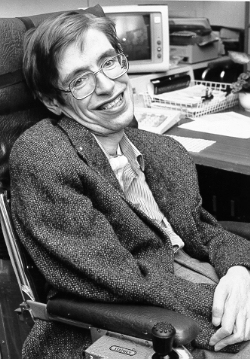
Stephen Hawking スティーヴン・ホーキング
すてぃーゔん・ほーきんぐ
Stephen Hawking (1942–2018) was an English theoretical physicist and cosmologist, known for the singularity theorems developed with Roger Penrose and for showing that black holes emit radiation (Hawking radiation). Diagnosed with motor neurone disease at 21, he kept working for more than half a century and became one of the best-known scientists in the world, above all through A Brief History of Time (1988).
- Birthplace – place of death
- Oxford – Cambridge, England
- Education
- University College, Oxford (BA physics); Trinity Hall, Cambridge (PhD 1966)
- Field
- Theoretical physics, cosmology
Early life
Stephen William Hawking was born on 8 January 1942 in Oxford, exactly 300 years after the death of Galileo, a coincidence he liked to mention. His father Frank was a medical researcher and his mother Isobel had also studied at Oxford. The family later settled in St Albans, near London.
At school Hawking was not a top student by marks, but his friends nicknamed him "Einstein". At 17 he won a scholarship to University College, Oxford, where he read physics and took a first-class degree. He then moved to Trinity Hall, Cambridge, to research cosmology under Dennis Sciama.
Illness
In 1963, aged just 21, Hawking was diagnosed with motor neurone disease (a form of ALS). Doctors expected him to live about two more years. The disease progressed far more slowly than predicted, and he lived for more than 50 years after the diagnosis.
He gradually lost the ability to walk and used a wheelchair. In 1985 a tracheotomy after pneumonia took away his voice, and from then on he spoke through a speech-generating device, first operated by a hand switch and later by a single cheek muscle. That synthetic voice became famous in its own right.
Scientific career
In the late 1960s Hawking and Roger Penrose proved singularity theorems showing that, under Einstein's general relativity, the universe must have begun from a singularity and collapsing stars form singularities inside black holes. The work gave strong support to the Big Bang model.
In 1974, combining relativity with quantum mechanics, he reached a startling conclusion: black holes are not completely black but emit thermal radiation and can slowly evaporate. This Hawking radiation was controversial at first but widely accepted by the late 1970s, and it raised the black hole information paradox that physicists still debate.
He was elected a Fellow of the Royal Society in 1974, aged 32. From 1979 to 2009 he held the Lucasian Chair of Mathematics at Cambridge, once occupied by Isaac Newton. With James Hartle he also proposed the "no-boundary" proposal for the initial state of the universe.
A Brief History of Time and public science
In 1988 he published A Brief History of Time, explaining the Big Bang, black holes and the nature of time for general readers. It spent a record 237 weeks on the Sunday Times bestseller list and had sold an estimated 9 million copies by 2009. It was followed by The Universe in a Nutshell (2001), The Grand Design (2010, with Leonard Mlodinow) and the George children's books written with his daughter Lucy.
Hawking appeared on television shows such as Star Trek, The Simpsons and The Big Bang Theory. He spoke out on big issues, warning about the risks of artificial intelligence and climate change and defending Britain's National Health Service.
Personal life and final years
In 1965 Hawking married Jane Wilde; they had three children, Robert, Lucy and Timothy. They divorced in 1995, and that year he married his nurse Elaine Mason; they divorced in 2006. Jane's memoir became the basis of the film The Theory of Everything (2014), which won Eddie Redmayne an Oscar for playing Hawking.
Hawking died at his home in Cambridge on 14 March 2018, aged 76. His ashes were interred in Westminster Abbey, not far from the graves of Isaac Newton and Charles Darwin.
Legacy and assessment
Hawking never received a Nobel Prize, since Hawking radiation has not been directly observed, something the Nobel committee usually requires. Physicists nonetheless regard his work as the first major step in linking relativity with quantum mechanics. Some colleagues felt his public fame outstripped his scientific standing, while others stress that this fame drew millions of people to science.
Beyond physics, Hawking became a symbol for people with disabilities, showing that severe illness need not stop a mind from working at the highest level.
Hawking in Vietnam and Japan
In Vietnam, A Brief History of Time and other Hawking books such as The Universe in a Nutshell and The Grand Design have been translated and reprinted many times, becoming standard introductions to cosmology for students. The Theory of Everything was also widely shown.
In Japan, A Brief History of Time appeared as Hōkingu, uchū o kataru ("Hawking Speaks of the Universe") and sold strongly in the late 1980s, making his name familiar even to people with no physics background.
Japanese corner
Name: スティーヴン・ホーキング (also スティーブン・ホーキング).
Key words: 理論物理学 (riron butsurigaku, theoretical physics), 宇宙論 (uchūron, cosmology), ブラックホール (burakku hōru, black hole), ホーキング放射 (Hōkingu hōsha, Hawking radiation), 特異点 (tokuiten, singularity), ビッグバン (biggu ban, Big Bang), 筋萎縮性側索硬化症 (kin'ishukusei sokusaku kōkashō, ALS), 車椅子 (kurumaisu, wheelchair).
文中词汇
- スティーヴン・ホーキング
- 理論物理学りろんぶつりがくtheoretical physics
- 宇宙論うちゅうろんcosmology
- ブラックホールblack hole
- ホーキング放射ホーキングほうしゃHawking radiation
- 特異点とくいてんsingularity; singular point
- ビッグバンbig bang
- 相対性理論そうたいせいりろんtheory of relativity
- 量子力学りょうしりきがくquantum mechanics
- 筋萎縮性側索硬化症きんいしゅくせいそくさくこうかしょうamyotrophic lateral sclerosis; ALS; Lou…
- 車椅子くるまいすwheelchair