Business & technology · 世界名人
Henry Ford ヘンリー・フォード
へんりー・ふぉーど
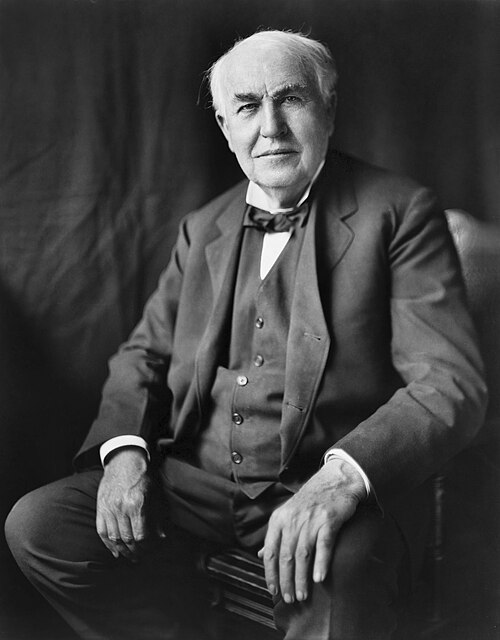
Henry Ford (1863 – 1947) was an American industrialist who founded the Ford Motor Company in 1903. With the Model T (1908) and the moving assembly line (1913) he turned the car from a luxury into an everyday vehicle and laid the foundations of modern mass production, known as "Fordism". He is also sharply criticised for his anti-union stance and antisemitic propaganda.
- Birthplace
- Farm in Springwells Township (now Dearborn), Michigan, USA
- Fields
- Automotive industry, engineering, business
- Company
- Ford Motor Company (founded 16 June 1903)

A farm boy who loved machines
Henry Ford was born on 30 July 1863 on a farm in Springwells Township near Detroit, Michigan, son of William Ford, an Irish immigrant, and Mary Litogot. He disliked farm work but loved taking apart watches and machines; neighbours brought him their watches to fix. His mother died in 1876, when he was thirteen.
In December 1879, aged sixteen, he left for Detroit to apprentice in machine shops, later servicing steam engines. In 1888 he married Clara Bryant; their only son, Edsel, was born in 1893. In 1891 he became an engineer with the Edison Illuminating Company in Detroit, rising to chief engineer in 1893. He met Thomas Edison, who encouraged his idea of a petrol-powered vehicle; the two later became close friends.
From the Quadricycle to Ford Motor Company
Working by day, Ford built cars at night in a shed behind his house. On 4 June 1896 he completed his first vehicle, the Quadricycle — a frame on four bicycle wheels with a petrol engine — and drove it through Detroit. In 1899 he and investors formed the Detroit Automobile Company, which soon failed because its cars were costly and unreliable.
Ford turned to racing cars for publicity; in October 1901 he drove to victory in a ten-mile race at Grosse Pointe. On 16 June 1903 he, the coal dealer Alexander Malcomson and other shareholders incorporated the Ford Motor Company. Its first Model A (1903) sold well, and by 1906 Ford controlled the company.
The Model T and the assembly line
In October 1908 Ford introduced the Model T — simple, tough, easy to repair and able to handle rough rural roads. His aim was a "car for the great multitude", cheap enough for workers to buy. Americans nicknamed it the "Tin Lizzie".
To cut costs, Ford and his engineers borrowed ideas from watchmaking, gunmaking, bicycle manufacture and Chicago meatpacking, and in autumn 1913 launched the first moving assembly line for cars at the Highland Park plant. Instead of workers moving around a car, the chassis was pulled past stations, each worker doing one task. Assembly time fell from over twelve hours to about an hour and a half. Ford did not invent the assembly line, but he applied it on an unprecedented scale.
The Model T's price fell from about $825 – 850 in 1908 (depending on source and body style) to $360 in 1916, and below $300 for some models by the mid-1920s. When production ended in 1927, more than 15 million had been built; at one point about half the cars in the world were Fords. The line attributed to him — customers could have "any colour so long as it is black" — captures his drive for standardisation.
The $5 day and Fordism
Repetitive assembly-line work was monotonous, and turnover was extremely high. On 5 January 1914 Ford stunned the world by announcing a $5 wage for an eight-hour day — nearly double the going rate. Thousands flocked to Detroit. The policy slashed turnover and let workers afford the cars they built.
The high wage came with conditions: the company's "Sociological Department" sent investigators into workers' homes to check their habits, drinking and family life. The model combining mass production, standardisation, high wages and mass consumption came to be called "Fordism" and shaped twentieth-century industry. Ford also built the vast River Rouge complex, where raw materials went in at one end and finished cars came out the other, and founded the rubber plantation Fordlândia in Brazil (1927), a failure.
The dark side: antisemitism and anti-unionism
From 1920 Ford's newspaper, The Dearborn Independent, ran antisemitic articles later collected as The International Jew, printed in hundreds of thousands of copies and translated into several languages, including German. Hitler praised Ford, and in 1938 Ford accepted a decoration from Nazi Germany. In 1927, under pressure from lawsuits and boycotts, Ford publicly apologised and closed the paper, but the damage had spread.
He was also fiercely anti-union. In 1937 company security men attacked United Auto Workers organisers in the "Battle of the Overpass". Only after a major strike in 1941 did Ford sign with the UAW. He was slow to innovate, too: he clung to the Model T while General Motors pulled ahead with varied models, switching to a new Model A only in 1927.
Last years and legacy
In 1918 Ford made his son Edsel company president but kept real control. In 1929 he opened the Edison Institute (now The Henry Ford museum) and Greenfield Village in Dearborn to celebrate invention and rural American life. When Edsel died in 1943, the 79-year-old Ford resumed the presidency, handing over to his grandson Henry Ford II in 1945. He died at Fair Lane on 7 April 1947, aged 83.
Ford is seen as one of the shapers of the twentieth century: affordable cars changed how people lived, worked and built cities, and mass production spread to every industry. The Ford Foundation (1936) became one of the world's largest philanthropies. History also records him as deeply contradictory: a visionary innovator who paid workers well, yet a propagator of antisemitism and a suppressor of unions.
Connections with Vietnam and Japan
In Vietnam, Ford Vietnam — a joint venture between Ford and the Song Cong Diesel Corporation — was set up in 1995, one of the first car joint ventures after Đổi Mới, with an assembly plant in Hải Dương. The "production line" and Ford-style mass production are basic concepts in Vietnamese engineering and management education.
In Japan, Ford set up an assembly plant in Yokohama in 1925, helping bring cars to prewar Japan. After World War II, Toyota leaders such as Toyoda Eiji visited Ford's River Rouge complex (1950) to learn. The Toyota Production System, with "just-in-time" and "kaizen", arose partly by adapting Ford's model to smaller, more varied production — and American carmakers later learned from Toyota in turn.
Japanese corner
His name is written ヘンリー・フォード; the Model T is T型フォード.
Key words: 自動車 (automobile), 大量生産 (mass production), 組立ライン/流れ作業 (assembly line), 実業家 (industrialist), 労働組合 (labour union), 日給 (daily wage), 標準化 (standardisation), トヨタ生産方式 (Toyota Production System).