
Science · 世界名人
Thomas Edison エジソン
えじそん
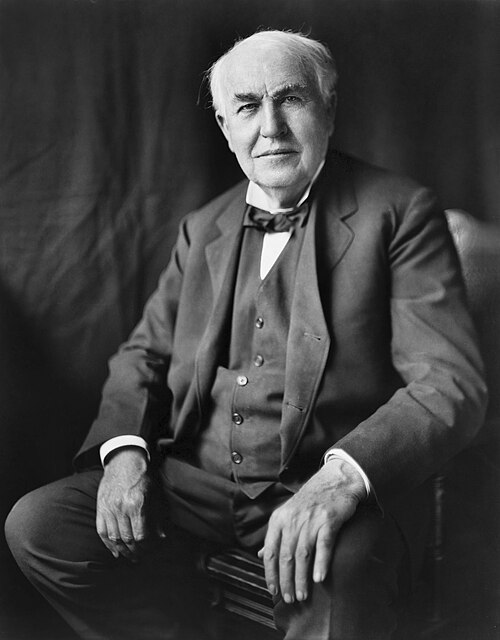
Thomas Alva Edison (1847–1931) was an American inventor and businessman who held 1,093 US patents. He is known for the phonograph (1877), a practical incandescent light bulb (1879), urban electric power systems and the kinetoscope. His Menlo Park laboratory is regarded as one of the first industrial research labs in the world.
- Birthplace – place of death
- Milan, Ohio – West Orange, New Jersey, US
- Nationality
- American
- Field
- Invention, electrical engineering, telecommunications, business
Early life
Thomas Alva Edison was born on 11 February 1847 in Milan, Ohio, the youngest of seven children. In 1854 the family moved to Port Huron, Michigan. He attended school for only a few months; most of his education came from his mother Nancy, a former teacher, along with his own reading and chemistry experiments in the basement.
Around the age of 12 he began to lose his hearing, probably because of scarlet fever and untreated ear infections. He sold newspapers and sweets on the Port Huron–Detroit railway and even printed a small newspaper on the train. After he saved a boy from being hit by a train, the boy's father taught him telegraphy.
From telegrapher to Menlo Park
From 1863 to 1869 Edison worked as a night-shift telegrapher in cities across the Midwest, tinkering with equipment in his spare time. His first patent, granted on 1 June 1869, was an electric vote recorder; it did not sell because legislators did not want faster voting. He took the lesson to heart: invent only what the market wants.
Moving to New York, he improved the stock ticker and developed the quadruplex telegraph, which earned him substantial money. In 1876 he used it to build a laboratory at Menlo Park, New Jersey, where engineers, machinists and chemists worked together in an organised way to produce inventions, a model of industrial research that many corporations later copied.
The phonograph and the electric light
In 1877 Edison invented the phonograph, the first device that could both record and play back sound, by etching vibrations onto a tinfoil-covered cylinder. It made him world-famous as the "Wizard of Menlo Park".
Edison did not invent the first electric light, but he produced an incandescent bulb that was durable, affordable and practical. After testing thousands of materials he filed a patent in November 1879 using a carbon filament, granted on 27 January 1880. His team later used carbonised bamboo, and bamboo from Yawata near Kyoto, Japan, gave the best results, lasting around 1,000 hours.
Just as important was the whole system around it: generators, wiring, meters and fuses. On 4 September 1882 the Pearl Street Station in Manhattan began supplying direct current to customers, opening the age of urban electrification.
The war of the currents and later years
Edison stuck with direct current (DC), while George Westinghouse and Nikola Tesla, who had briefly worked for Edison, promoted alternating current (AC), which could be transmitted far more efficiently. In the "war of the currents" of the late 1880s, Edison's side campaigned publicly that AC was dangerous, including backing Harold P. Brown's animal electrocution demonstrations. AC won out, and in 1892 Edison's company merged with Thomson-Houston to form General Electric.
In 1887 he built a larger laboratory at West Orange, which produced the kinetoscope, improved phonographs, alkaline storage batteries and much more. Not every venture succeeded: his iron ore separation project at Ogden lost him a great deal of money. In his last years he worked with his friends Henry Ford and Harvey Firestone on finding a domestic source of rubber.
Family and death
In 1871 Edison married Mary Stilwell, who died in 1884 aged 29. In 1886 he married Mina Miller. He had six children; Charles Edison later became Governor of New Jersey. Absorbed in his work, Edison is described by many biographers as a neglectful father.
He died at his home, Glenmont, in West Orange on 18 October 1931, aged 84.
Assessment and legacy
Edison is often seen as the model inventor-entrepreneur, turning ideas into products and whole industries, from electric power and sound recording to film. His team-based research at Menlo Park strongly influenced corporate laboratories of the 20th century.
He has also been criticised for taking credit for work his staff contributed heavily to, for the campaign against alternating current and for driving employees to exhaustion. His relationship with Tesla is often dramatised online; historians see both as having made distinct contributions. The saying "Genius is one percent inspiration and ninety-nine percent perspiration" is widely attributed to him, though the version usually quoted was published in 1932, after his death.
Connections with Vietnam and Japan
In Vietnam, Edison is a familiar figure in children's books and school textbooks, associated with the story of testing thousands of materials for the light bulb and the "99 percent perspiration" saying.
Japan has a concrete connection: bamboo from Yawata (now Yawata City, Kyoto Prefecture), around Mount Otokoyama and the Iwashimizu Hachimangū shrine, was used for his lamp filaments for about ten years. A memorial to Edison stands beside the shrine today, and Yawata is twinned with his birthplace, Milan, Ohio. Edison also had a Japanese assistant, Okabe Yoshirō.
Japanese corner
Name: トーマス・エジソン, usually just エジソン.
Key words: 発明家 (hatsumeika, inventor), 特許 (tokkyo, patent), 白熱電球 (hakunetsu denkyū, incandescent light bulb), 蓄音機 (chikuonki, phonograph), 竹 (take, bamboo), 直流 (chokuryū, direct current), 交流 (kōryū, alternating current), 天才 (tensai, genius), 努力 (doryoku, effort).
文中词汇
- エジソン
- 発明家はつめいかinventor
- 発明王はつめいおうmaster inventor; king of inventors (e.g…
- 特許とっきょpatent
- 白熱電球はくねつでんきゅうlight bulb; incandescent light bulb
- 蓄音機ちくおんきgramophone; phonograph
- フィラメントfilament
- 竹たけbamboo (any grass of subfamily Bambusoi…
- 直流ちょくりゅうdirect current; DC
- 交流こうりゅうexchange (e.g. cultural); interchange; …
- 研究所けんきゅうじょresearch institute; (research) laborato…
- 天才てんさいgenius; prodigy; natural gift


