
Reactions & substances · Chemistry
Water in chemistry 化学から見た水
みず
Water (H2O) has two hydrogen atoms and one oxygen atom. Its polarity and hydrogen bonds give it unusual properties and make it the solvent of life.
- Formula
- H2O
- Molecular mass
- 18
- Boiling point (1 atm)
- 100 °C
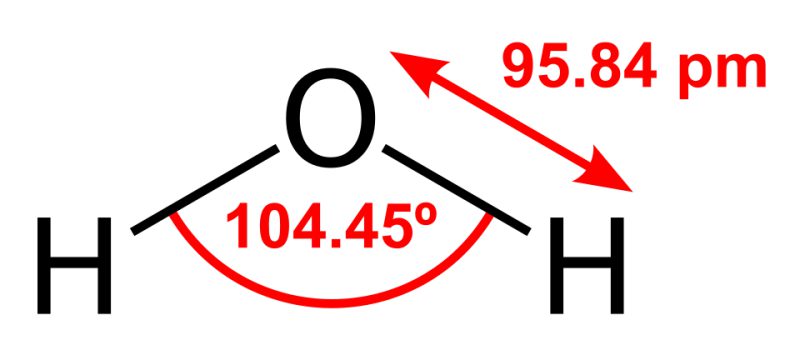
A bent molecule
The two H atoms attach to O at about 104.5°, giving water a bent shape. Oxygen pulls electrons strongly and carries a partial negative charge, while the H atoms are partly positive.
Hydrogen bonds and odd properties
Water molecules attract each other through hydrogen bonds, so water boils at 100 °C, much higher than similar small molecules. Ice is less dense than liquid water and floats, letting fish survive under winter ice.
The universal solvent
Thanks to its polarity, water dissolves salt, sugar and many other substances. Blood, sap and seawater are all water solutions. Oils, being nonpolar, do not dissolve in water.
Hard water and treatment
Water rich in Ca2+ and Mg2+ is hard water; it leaves scale in kettles and stops soap from lathering. Tap water is usually filtered and disinfected with chlorine before reaching homes.
Japanese – English terms
水 (みず) – water; 水素結合 (すいそけつごう) – hydrogen bond; 極性分子 (きょくせいぶんし) – polar molecule; 溶媒 (ようばい) – solvent; 硬水 (こうすい) – hard water; 軟水 (なんすい) – soft water; 密度 (みつど) – density.