
Ancient world · World history
Mesopotamia メソポタミア文明
めそぽたみあぶんめい
Mesopotamia, the land between the Tigris and Euphrates rivers (mostly modern Iraq), was home to one of the earliest civilizations, with city-states, cuneiform writing and written law codes.
- Period
- c. 3500 BC – 6th century BC
- Main peoples
- Sumerians, Akkadians, Babylonians, Assyrians
- Achievements
- Cuneiform, Code of Hammurabi, base-60 counting
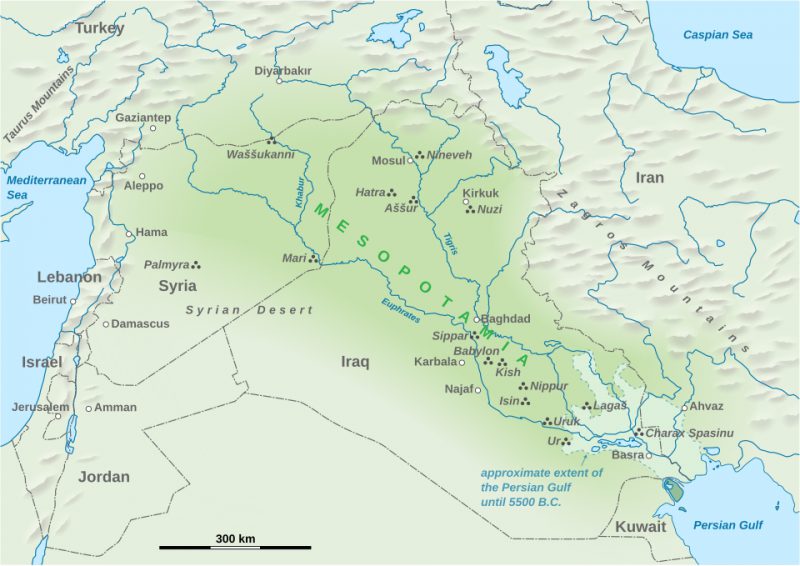
The land between two rivers
"Mesopotamia" is Greek for "the land between the rivers". Floods left fertile silt, but rainfall was low, so people dug canals to irrigate fields. Organizing this shared work required leaders and helped give rise to the state.
Around 3500 BC the Sumerians built city-states such as Uruk and Ur. Each had walls, a stepped temple tower (ziggurat) and a king who also led religious life.
Cuneiform and the Code of Hammurabi
Sumerians pressed reeds into wet clay, making wedge-shaped marks called cuneiform. Writing began as records of grain and livestock, like an early account book, and later recorded letters, laws and literature such as the Epic of Gilgamesh.
Around the 18th century BC, King Hammurabi of Babylon had a code of nearly 300 laws carved on a stone pillar. It is known for "an eye for an eye", though penalties also depended on social rank.
Legacy
Mesopotamians counted in base 60, which is why an hour has 60 minutes and a circle 360 degrees. They also developed a lunar calendar, the wheel and considerable astronomy.
From the 6th century BC the region came under the Persian Empire and later empires, but many Mesopotamian achievements passed to Greece and other cultures.
Japanese – English terms
楔形文字 (くさびがたもじ): cuneiform; 都市国家 (としこっか): city-state; ハンムラビ法典 (はんむらびほうてん): Code of Hammurabi; 灌漑 (かんがい): irrigation; 六十進法 (ろくじゅうしんほう): sexagesimal system; 粘土板 (ねんどばん): clay tablet.