
Ancient world · World history
Ancient Greece 古代ギリシャ
こだいぎりしゃ
Ancient Greece was a world of city-states (poleis) such as Athens and Sparta that gave birth to Athenian democracy, philosophy, the Olympic Games and many foundations of Western culture.
- Classical period
- 5th – 4th century BC
- Major poleis
- Athens, Sparta, Corinth
- Key figures
- Pericles, Socrates, Plato, Aristotle
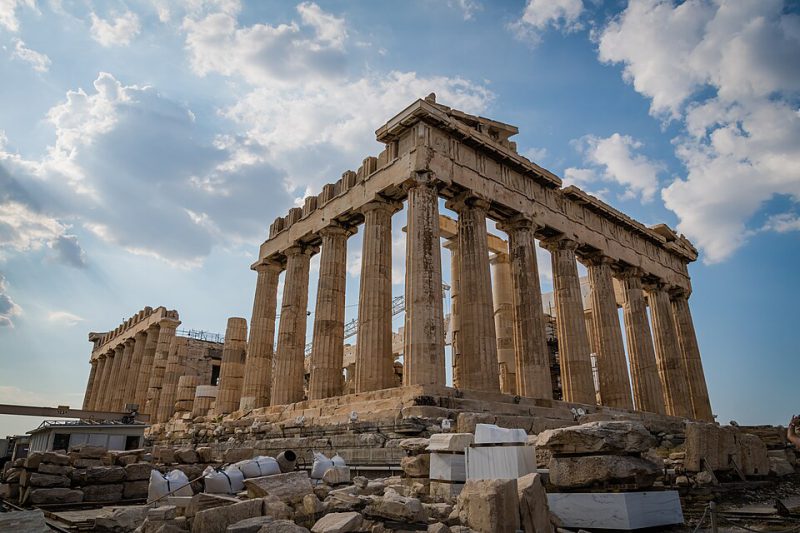
A world of city-states
Greece is mountainous with little farmland, so Greeks lived in hundreds of small independent city-states, or poleis, each a city with its surrounding countryside. They traded by sea and founded new cities around the Mediterranean.
Though divided, Greeks shared a language, myths and the Olympic Games at Olympia, traditionally dated from 776 BC.
Athens and democracy
In 5th-century BC Athens, adult male citizens met in the Assembly to vote directly on laws and war, and many offices were filled by lot. This was direct democracy, though women, slaves and foreigners had no political rights.
Sparta took another path: a strict military society where boys trained from childhood to be soldiers. Rivalry led to the Peloponnesian War (431–404 BC), which Sparta won.
Philosophy, science and the Hellenistic age
Socrates asked questions to make people think for themselves; his student Plato founded the Academy, and Aristotle studied everything from logic to biology. Euclid in geometry and Archimedes with his principle of buoyancy were also Greek.
Alexander the Great (356–323 BC) conquered an empire from Greece to Egypt and India, spreading Greek culture across the East. The following era is called the Hellenistic period.
Japanese – English terms
ポリス (ぽりす): polis (city-state); 民主政 (みんしゅせい): democracy; 民会 (みんかい): assembly; 哲学 (てつがく): philosophy; ヘレニズム (へれにずむ): Hellenism; オリンピア (おりんぴあ): Olympia.