
Core ideas · Mathematics
Pi (π) 円周率
えんしゅうりつ
Pi is the ratio of any circle's circumference to its diameter, about 3.14159. It is irrational, with decimals that go on forever without repeating.
- Value
- ≈ 3.14159
- Type
- Irrational, transcendental
- Pi Day
- March 14
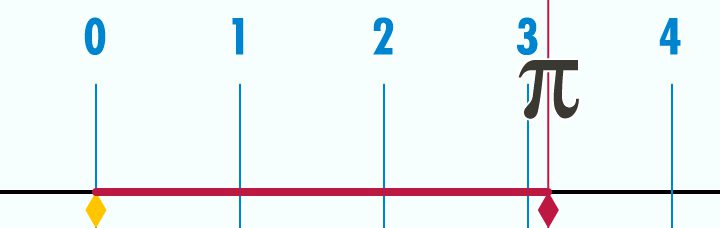
What is π?
For any circle, big or small, circumference divided by diameter gives the same number, π. So circumference = π × diameter and area = π × r × r.
History of computing π
Archimedes (3rd century BC) squeezed the circle between 96-sided polygons and showed π lies between 3 10/71 and 3 1/7. Zu Chongzhi in 5th-century China found 355/113, correct to six decimals. Computers now give trillions of digits.
Special properties
Lambert proved π irrational in 1761, and Lindemann proved it transcendental in 1882, which showed that "squaring the circle" with ruler and compass is impossible.
π in everyday life
π appears when working out how far a wheel rolls, the volume of a can, and in sound waves and oscillations. Japanese students commonly use π ≈ 3.14.
Japanese – English terms
Key terms (Japanese – English – Vietnamese): 円周率 (えんしゅうりつ) – pi – số pi; 円周 (えんしゅう) – circumference – chu vi đường tròn; 直径 (ちょっけい) – diameter – đường kính; 半径 (はんけい) – radius – bán kính; 無理数 (むりすう) – irrational number – số vô tỉ; 超越数 (ちょうえつすう) – transcendental number – số siêu việt.