
Core ideas · Mathematics
Matrix 行列
ぎょうれつ
A matrix is a rectangular table of numbers in rows and columns, used to solve systems of equations, transform images and process big data, including AI.
- Named by
- James Joseph Sylvester (1850)
- Main operations
- Addition, multiplication, inverse, determinant
- Applications
- 3D graphics, AI, economics
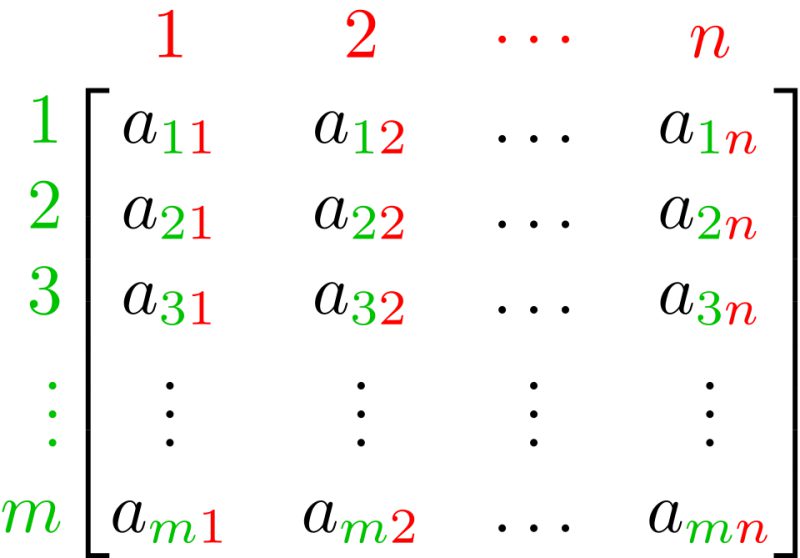
What is a matrix?
A class grade sheet, with one row per student and one column per subject, is a matrix. A matrix with m rows and n columns is called m × n. In Japanese, 行 means row and 列 means column.
Matrix multiplication
Multiplying matrices pairs each row of the first with each column of the second, multiplying and adding. It is not commutative: A × B usually differs from B × A.
Solving systems
A system like 2x + y = 5, x − y = 1 can be written A × X = B. If the determinant of A is nonzero, the inverse exists and X = A⁻¹ × B. Computers solve systems with thousands of unknowns this way.
Modern uses
In 3D games, every rotation or zoom is a matrix multiplication. Digital images are matrices of pixels, and AI neural networks are essentially huge chains of matrix multiplications run on GPUs.
Japanese – English terms
Key terms (Japanese – English – Vietnamese): 行列 (ぎょうれつ) – matrix – ma trận; 行 (ぎょう) – row – hàng; 列 (れつ) – column – cột; 行列式 (ぎょうれつしき) – determinant – định thức; 逆行列 (ぎゃくぎょうれつ) – inverse matrix – ma trận nghịch đảo; 連立方程式 (れんりつほうていしき) – system of equations – hệ phương trình; 線形代数 (せんけいだいすう) – linear algebra – đại số tuyến tính.