
Electricity, magnetism & light · Physics
Electromagnetic induction 電磁誘導
でんじゆうどう
Electromagnetic induction is the generation of current by a changing magnetic flux. Faraday discovered it in 1831, and almost all the electricity we use today is generated this way.
- Discovered by
- Michael Faraday (1831)
- Related laws
- Faraday's law, Lenz's law
- Applications
- Generators, transformers, induction cookers, wireless charging
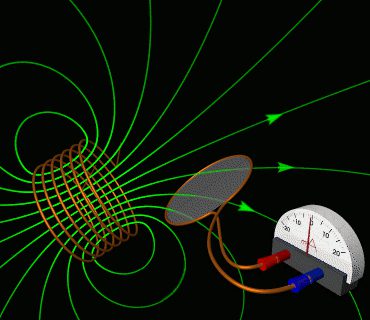
Faraday's experiment
Move a magnet toward or away from a coil connected to a meter and the needle swings; hold the magnet still and nothing happens. What matters is changing flux. The faster the flux changes, the larger the induced EMF.
Lenz's law
The induced current always opposes the change that produces it. This is nature conserving energy: to get electricity you must do work pushing the magnet. Eddy-current brakes on high-speed trains use this to slow down without friction.
Generators and transformers
In hydro or thermal power plants, turbines spin coils in magnetic fields to make AC. Transformers use induction between two coils to raise voltage for long-distance transmission (cutting losses) and lower it to household levels. Induction cookers and wireless phone chargers also rely on induction.
Japanese – English terms
電磁誘導 (でんじゆうどう) – electromagnetic induction; 磁束 (じそく) – magnetic flux; 誘導起電力 (ゆうどうきでんりょく) – induced EMF; コイル (こいる) – coil; 発電機 (はつでんき) – generator; 変圧器 (へんあつき) – transformer.