
Electricity, magnetism & light · Physics
Magnetic field 磁場
じば
A magnetic field is the region around a magnet or current where magnetic forces act. It makes compasses point north, electric motors turn and shields Earth from the solar wind.
- Unit of flux density
- Tesla (T)
- Key discovery
- Ørsted (1820): currents create magnetic fields
- Applications
- Compasses, motors, speakers, MRI
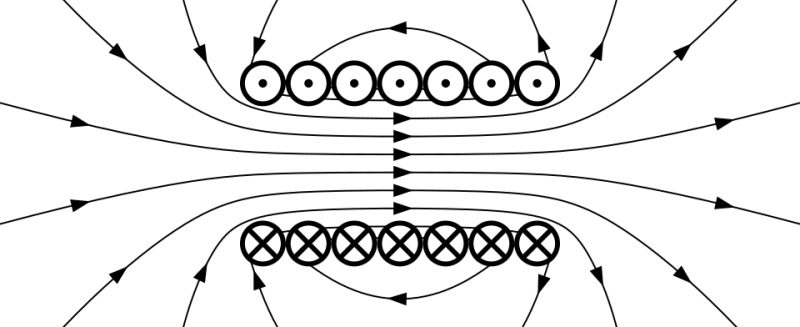
Magnets and field lines
A magnet has north and south poles; like poles repel and unlike poles attract. Iron filings around a magnet trace curves between the poles, showing field lines. Earth itself is a giant magnet.
Currents make magnetic fields
In 1820 Ørsted saw a compass needle swing near a current-carrying wire. Winding wire around an iron core gives an electromagnet that can be switched on and off. Scrapyard cranes use electromagnets to lift steel.
Magnetic force and its uses
A magnetic field pushes on current-carrying wires and moving charges (the Lorentz force), the principle of motors and speakers. Hospital MRI scanners use very strong fields to image the body. Auroras appear when solar particles are guided to the poles by Earth's field.
Japanese – English terms
磁石 (じしゃく) – magnet; 磁場 (じば) – magnetic field; 磁力線 (じりょくせん) – magnetic field line; 電磁石 (でんじしゃく) – electromagnet; ローレンツ力 (ろーれんつりょく) – Lorentz force; 方位磁針 (ほういじしん) – compass needle.