
Modern physics · Physics
Theory of relativity 相対性理論
そうたいせいりろん
Einstein's relativity comprises special relativity (1905) and general relativity (1915). It shows space and time are not absolute, mass is equivalent to energy (E = m × c²), and gravity is the curvature of spacetime.
- Proposed by
- Albert Einstein
- Years
- 1905 (special), 1915 (general)
- Applications
- GPS corrections, nuclear energy, astronomy
Special relativity: constant light speed
Einstein assumed the speed of light in vacuum is the same for all uniformly moving observers. Strange consequences follow: fast-moving clocks run slow (time dilation) and fast objects shorten along their motion. These effects matter only near light speed.
E = m × c²
Physics' most famous equation says mass can be turned into energy. Because c² is huge, a tiny mass corresponds to enormous energy. This powers the Sun and nuclear power plants.
General relativity: gravity as curved spacetime
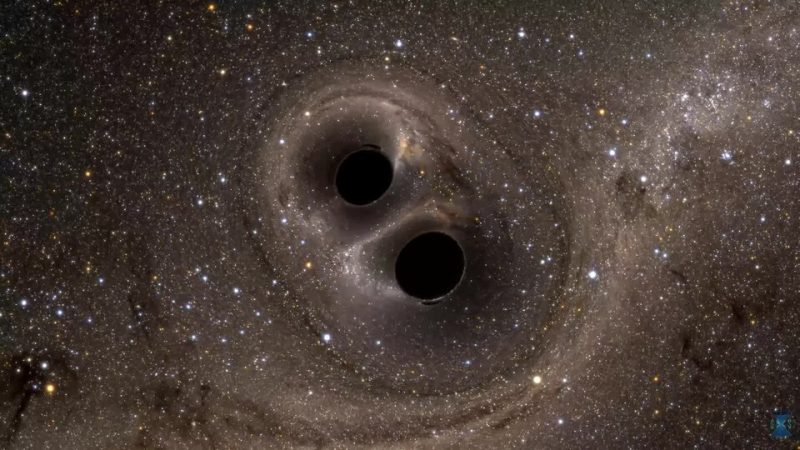
Imagine a bowling ball on a rubber sheet: the sheet sags and a marble rolling nearby curves around it. Likewise, mass curves spacetime and other bodies follow that curvature. The theory predicts light bending near the Sun, black holes and gravitational waves (directly detected in 2015).
Clocks on GPS satellites drift relative to the ground because of both relativistic effects; without correction, GPS positions would grow increasingly wrong.
Japanese – English terms
相対性理論 (そうたいせいりろん) – theory of relativity; 光速 (こうそく) – speed of light; 時間の遅れ (じかんのおくれ) – time dilation; 時空 (じくう) – spacetime; 重力波 (じゅうりょくは) – gravitational wave; ブラックホール (ぶらっくほーる) – black hole.