
Modern physics · Physics
Nuclear energy 核エネルギー
かくえねるぎー
Nuclear energy is released when atomic nuclei change: heavy nuclei split (fission) or light nuclei join (fusion). It supplies electricity in many countries and powers the stars.
- Basis
- Mass defect, E = m × c²
- Fission discovered
- Hahn, Strassmann, Meitner (1938–1939)
- Applications
- Nuclear power, nuclear medicine, radiometric dating
Radioactivity
In 1896 Becquerel found uranium salts emit radiation spontaneously; Marie and Pierre Curie studied it and discovered polonium and radium. Unstable nuclei decay, emitting alpha, beta or gamma radiation. Half-life is the time for half the nuclei to decay; carbon-14's is about 5,730 years, used to date artefacts.
Fission and nuclear power plants
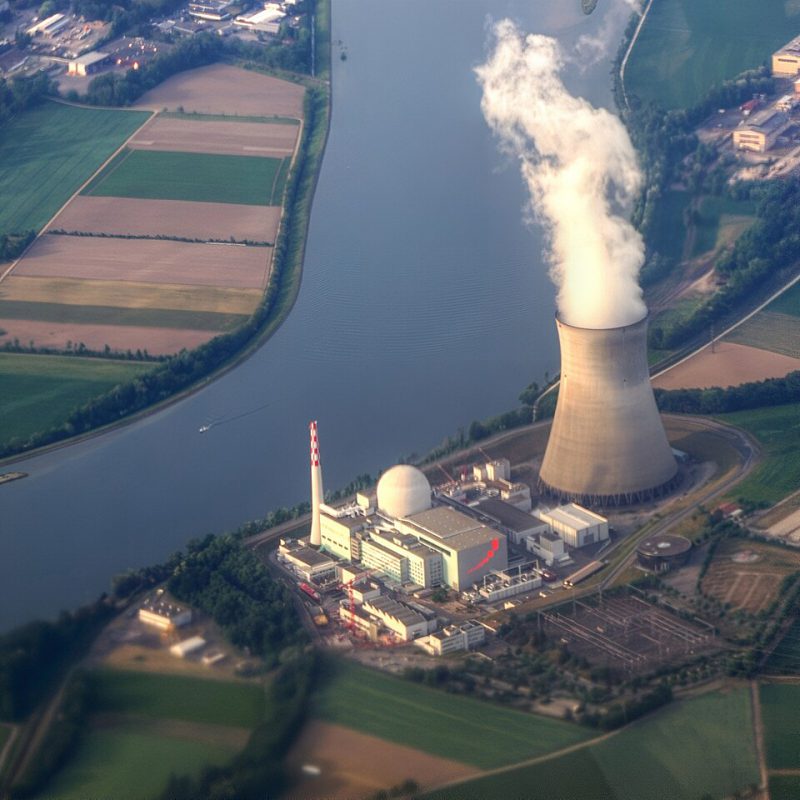
When a uranium-235 nucleus absorbs a neutron, it splits into two smaller nuclei and releases a few neutrons that can cause more fission: a chain reaction. In a reactor, control rods regulate it; the heat boils water to drive turbines.
Nuclear power emits almost no CO₂ in operation but raises concerns about safety (such as Chernobyl in 1986 and Fukushima in 2011) and long-term radioactive waste. Countries make different choices about expanding or reducing it.
Fusion: the Sun's energy
In the Sun's core, hydrogen nuclei fuse into helium, and the slight mass lost becomes energy by E = m × c². Researchers are developing fusion reactors (such as the international ITER project) because fuel is plentiful and long-lived waste is low, but sustaining plasma at hundreds of millions of degrees remains very difficult.
Japanese – English terms
放射能 (ほうしゃのう) – radioactivity; 半減期 (はんげんき) – half-life; 核分裂 (かくぶんれつ) – nuclear fission; 核融合 (かくゆうごう) – nuclear fusion; 連鎖反応 (れんさはんのう) – chain reaction; 原子炉 (げんしろ) – nuclear reactor; 質量欠損 (しつりょうけっそん) – mass defect.