
Modern physics · Physics
Semiconductors 半導体
はんどうたい
Semiconductors such as silicon have conductivity between metals and insulators, and it can be controlled. They are the material of diodes, transistors, computer chips, LEDs and solar cells.
- Typical materials
- Silicon (Si), germanium (Ge), GaN
- Transistor invented
- Bardeen, Brattain, Shockley (1947)
- Applications
- Microchips, LEDs, solar cells, sensors
Energy bands and the band gap
According to quantum mechanics, electrons in solids can only have energies within "bands". In metals electrons move freely; in insulators the band gap is too wide to jump. Semiconductors have a narrow gap: heat or light lets some electrons jump to the conduction band and carry current.
Doping: n-type and p-type
Adding a tiny amount of phosphorus to silicon gives extra electrons: n-type. Adding boron creates positive "holes": p-type. Joining them makes a p-n junction that passes current one way: a diode. An LED emits light when electrons and holes meet; a solar cell does the reverse, turning light into electricity.
Transistors and microchips
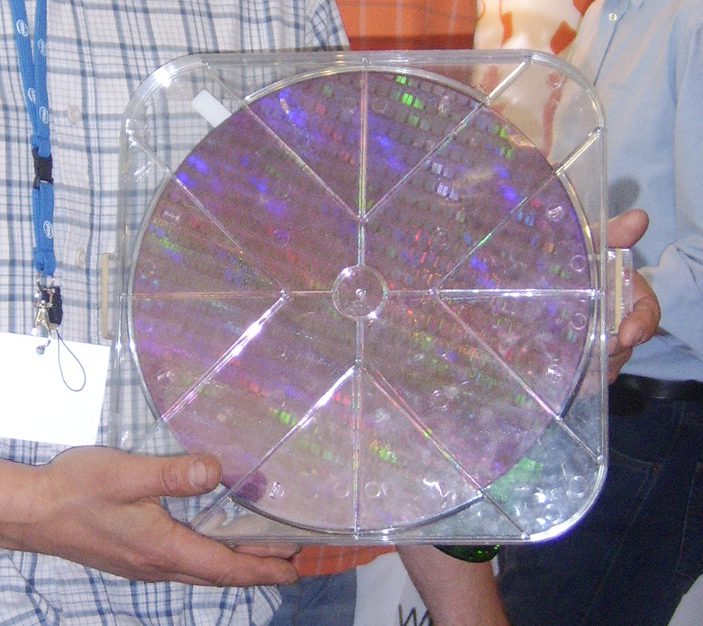
A transistor works as a tiny electronic switch flipping billions of times per second, the foundation of digital circuits. A modern phone chip holds billions of transistors on a fingernail-sized piece of silicon. Semiconductors are now a strategic industry with supply chains spanning many countries, including Japan and Vietnam.
Japanese – English terms
半導体 (はんどうたい) – semiconductor; バンドギャップ (ばんどぎゃっぷ) – band gap; 正孔 (せいこう) – hole; pn接合 (ぴーえぬせつごう) – p-n junction; ダイオード (だいおーど) – diode; トランジスタ (とらんじすた) – transistor; 集積回路 (しゅうせきかいろ) – integrated circuit.