
Planet Earth · Earth & the universe
Earth's structure 地球の内部構造
ちきゅうのないぶこうぞう
Earth is layered like an egg: a thin outer crust, a thick mantle and an iron-nickel core at the centre.
- Main layers
- Crust, mantle, outer core, inner core
- Age
- About 4.6 billion years
- How we know
- Seismic waves
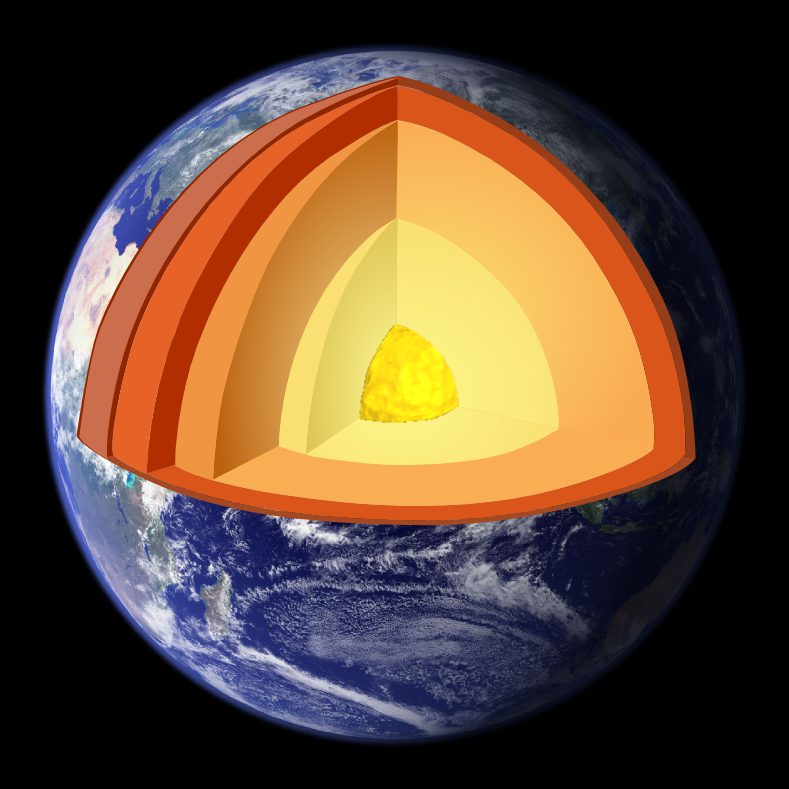
The layers
Compare Earth to a boiled egg. The crust is the shell, only about 5–10 km thick under oceans and typically 30–50 km under continents. The mantle, like the white, is nearly 2,900 km of hot rock that creeps slowly. The core is the yolk: a liquid outer core and solid inner core of mostly iron and nickel.
How we know what is inside
Humans have never drilled deeper than about 12 km. Knowledge of the interior comes from seismic waves, which change speed and direction between layers. S waves cannot pass through liquid, revealing that the outer core is molten.
The magnetic field
Moving liquid iron in the outer core generates Earth's magnetic field. It makes compass needles point north and shields Earth from much of the solar wind, helping protect the atmosphere and life.
Japanese – English terms
Vocabulary: 地殻 (ちかく) – crust; マントル – mantle; 外核 (がいかく) – outer core; 内核 (ないかく) – inner core; 地震波 (じしんは) – seismic wave; 地磁気 (ちじき) – geomagnetism.