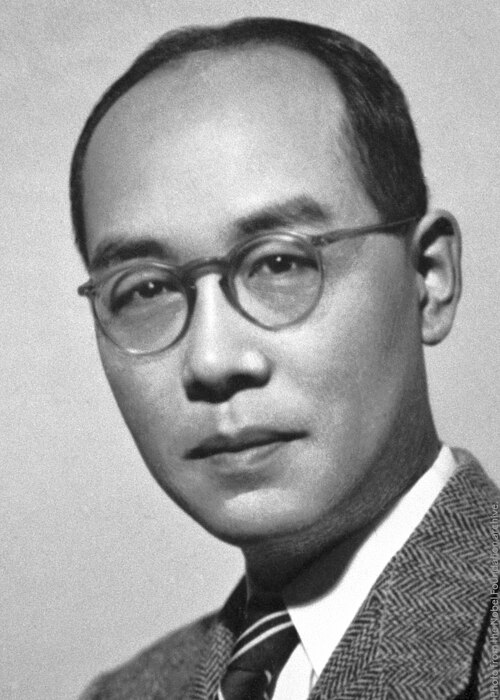
Science & business · 日本名人
Shinya Yamanaka 山中伸弥
やまなか しんや
Shinya Yamanaka (born 1962) is a Japanese medical scientist who discovered how to reprogram adult cells into induced pluripotent stem (iPS) cells. The discovery earned him a share of the 2012 Nobel Prize in Physiology or Medicine with the British biologist John Gurdon, and made him the face of Japanese regenerative medicine.
- Birthplace
- Higashiosaka, Osaka
- Nationality
- Japanese
- Education
- Kobe University (MD, 1987); PhD, Osaka City University (1993)

Early life
Yamanaka was born on 4 September 1962 in Higashiosaka, a small industrial city east of Osaka. His father ran a small factory making sewing-machine parts and urged his son to become a doctor. He did judo at school and rugby at university, breaking bones more than ten times, which drew him to orthopaedics.
He graduated from Kobe University School of Medicine in 1987 and trained as an orthopaedic surgeon at the National Osaka Hospital. In later interviews he described himself as a clumsy, slow surgeon, nicknamed "Jamanaka" (from jama, "nuisance") by colleagues. Seeing patients with diseases medicine could not treat pushed him towards basic research.
From Osaka to San Francisco
Yamanaka studied pharmacology at Osaka City University's graduate school and received his PhD in 1993. That year he went to the Gladstone Institutes in San Francisco as a postdoc, where he worked with genetically modified mice and embryonic stem (ES) cells, which can become almost any tissue.
Returning in 1996 as an assistant at Osaka City University, he struggled with scarce funding and little interest in mouse research, a slump he jokingly called "PAD" (post-America depression); he even considered going back to clinical work.
In 1999 he became an associate professor at the Nara Institute of Science and Technology (NAIST), with his own lab for the first time. He set a bold goal: making cells with ES-like properties without using embryos. He became a professor in 2003 and moved to Kyoto University's Institute for Frontier Medical Sciences in 2004.
Discovering iPS cells
His team screened 24 candidate genes linked to ES-cell pluripotency and narrowed them down. In August 2006 he and researcher Kazutoshi Takahashi reported in Cell that introducing just four genes — Oct3/4, Sox2, Klf4 and c-Myc, later called the "Yamanaka factors" — into mouse fibroblasts turned them into ES-like cells, which he named induced pluripotent stem (iPS) cells.
In November 2007 the team reported iPS cells from human skin cells, as did James Thomson's group in the US at the same time. The finding overturned the idea that cell differentiation runs only one way.
Because iPS cells can be made from a patient's own cells, they avoid the ethical problem of destroying human embryos and reduce rejection risk. But risks remain — c-Myc is linked to cancer — so the methods have been steadily refined.
CiRA, the Nobel Prize and clinical use
In 2010 Kyoto University established the Center for iPS Cell Research and Application (CiRA) with Yamanaka as its first director, a post he held until 2022 before continuing as a professor there. He also kept a lab at the Gladstone Institutes.
On 8 October 2012 the Nobel Committee awarded the Prize in Physiology or Medicine to John Gurdon and Yamanaka "for the discovery that mature cells can be reprogrammed to become pluripotent". Gurdon had shown this in frogs by nuclear transfer in 1962, the year Yamanaka was born; Yamanaka showed it could be done with a handful of genes. Six years from paper to prize is remarkably short.
Clinical uses followed: in 2014 Masayo Takahashi's team at RIKEN transplanted iPS-derived retinal cells into a patient with macular degeneration, followed by trials for Parkinson's, heart disease and spinal cord injury. CiRA built an iPS cell stock from donors with widely compatible immune types, supplying cells from 2015. iPS cells are also used to model diseases and screen drugs.
Style and work beyond the lab
Yamanaka often cites the motto "VW" he learned at Gladstone: Vision and Hard Work. He speaks plainly, with Kansai humour, and often tells of his own failures to encourage young researchers.
Because many CiRA staff are on short contracts, he has raised money himself, including by running marathons for the iPS research fund. He has also spoken on research ethics and patents: CiRA holds iPS patents largely to keep them widely available to other researchers at low cost.
In 2020 he set up the CiRA Foundation to produce high-quality iPS cells more cheaply, aiming at "my iPS" — personalised iPS cells for each patient.
Assessment and legacy
iPS cells are seen as one of the biggest biomedical breakthroughs of the early 21st century, opening embryo-free regenerative medicine. Even before the Nobel, Yamanaka won the Lasker (2009), Kyoto Prize (2010) and Wolf Prize (2011); in 2012 he received the Order of Culture and in 2013 the first Breakthrough Prize.
Many scientists, Yamanaka included, stress that widespread therapy is still a long way off: producing cells is costly, long-term safety must be proven, and some uses may come from ES cells or other techniques. In Japan, high post-Nobel expectations also sparked debate about how research funding is allocated. Still, iPS cells are now a standard tool in biology labs worldwide.
Japanese corner
His name is written 山中伸弥 (Yamanaka Shin'ya): 山中 means "in the mountains", 伸 "to stretch". He is usually called 山中先生 (Yamanaka-sensei).
iPS stands for induced pluripotent stem cell (Japanese 人工多能性幹細胞, jinkō tanōsei kansaibō). He deliberately wrote the "i" in lower case, iPod-style, to make the name catchy.
Vocabulary: 幹細胞 (kansaibō, stem cell), 再生医療 (saisei iryō, regenerative medicine), 初期化 (shokika, reprogramming — also a factory reset), 遺伝子 (idenshi, gene), 臨床研究 (rinshō kenkyū, clinical research), 整形外科 (seikei geka, orthopaedics).