
Science & business · 日本名人
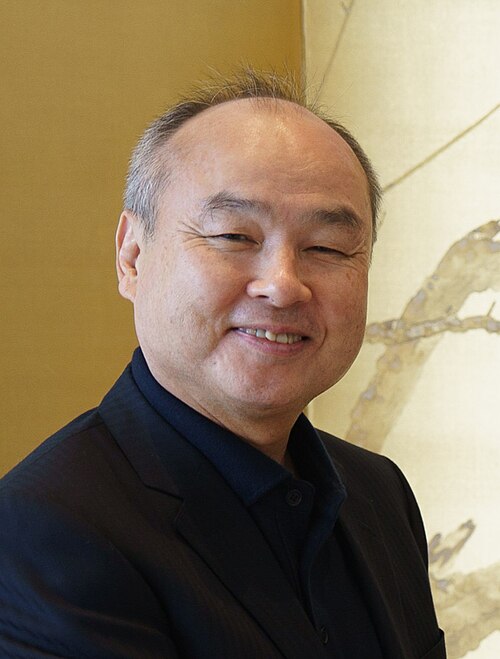
Masayoshi Son 孫正義
そん まさよし
Masayoshi Son (born 1957) is the founder, chairman and CEO of SoftBank Group and one of Asia's best-known entrepreneurs and technology investors. From a software distributor founded in 1981 he built a telecom and investment group behind deals such as Yahoo! Japan, Alibaba, Vodafone Japan, Arm, the Vision Fund and, more recently, OpenAI and the Stargate project.
- Hometown
- Tosu, Saga Prefecture
- Education
- Economics, University of California, Berkeley
- Field
- Business, telecoms, technology investment
Early life
Son was born on 11 August 1957 in Tosu, Saga Prefecture (Kyushu), into a family of Korean residents of Japan (Zainichi). The family was poor in his early childhood, though his father later prospered in business. He has said his Korean surname exposed him to discrimination as a child; he later became a Japanese citizen but kept the surname Son (孫).
As a teenager he was inspired by “Ryōma ga Yuku”, a novel about Sakamoto Ryōma, and by Den Fujita, founder of McDonald's Japan. At 16 he left high school in Fukuoka for the United States, studied English, passed a high-school equivalency exam and went on to study economics at the University of California, Berkeley.
First ventures and early SoftBank
As a student he developed a talking electronic translator with professors and sold the patent to Sharp for about US$1 million, and also imported arcade game machines from Japan. The story is often cited as an example of his habit of generating an invention idea every day.
Back in Japan, in September 1981 he founded Nippon SoftBank (now SoftBank Group) in Fukuoka, distributing PC software and publishing computer magazines. The company grew with the PC boom, listed in 1994 and used the capital to buy US tech businesses such as the COMDEX trade show and publisher Ziff-Davis.
Internet, Alibaba and telecoms
He invested early in Yahoo! and in 1996 set up the Yahoo! Japan joint venture, which became Japan's largest internet portal. In 2000, after a brief meeting with Jack Ma, SoftBank invested about US$20 million in the young Alibaba; by Alibaba's 2014 listing that stake was worth tens of billions of dollars, often called one of the most successful venture investments ever.
In the early 2000s SoftBank launched the cheap Yahoo! BB ADSL broadband service, handing out free modems on the street, breaking the incumbent's dominance and pushing Japanese internet prices down sharply. In 2006 he bought Vodafone K.K. for about ¥1.75 trillion, renaming it SoftBank Mobile; in 2008 it became the first carrier to sell the iPhone in Japan, helping it compete with NTT Docomo and au (KDDI).
In 2013 SoftBank bought a majority of US carrier Sprint; the deal struggled, and in 2020 Sprint merged into T-Mobile.
Arm, the Vision Fund and AI
In 2016 SoftBank bought British chip designer Arm for about £24 billion; Arm's architecture is in nearly every smartphone. Arm re-listed on Nasdaq in 2023, with Son as chairman.
In 2017 he launched the roughly US$100 billion SoftBank Vision Fund, largely backed by Saudi Arabia's Public Investment Fund, investing in Uber, WeWork, DoorDash, ByteDance and many other startups. The collapse of WeWork's valuation in 2019 and the tech-stock slump led to heavy losses, in some years tens of billions of dollars.
From around 2023 Son refocused on artificial intelligence, speaking of “artificial superintelligence”. In January 2025 he, OpenAI, Oracle and MGX announced the Stargate AI-infrastructure project in the US, targeting US$500 billion over four years, with Son as chairman; SoftBank has also made successive large investments in OpenAI.
Style and assessment
Son is known for long-range visions — in 2010 he unveiled a “30-year vision” for SoftBank — and for big, debt-financed bets. He often speaks of the Information Revolution and of daring to move ahead of his time.
Admirers see a visionary whose wins — Yahoo! Japan, Alibaba, Arm — were enormous. Critics point to Sprint, WeWork and the group's heavy debt; his personal fortune reportedly fell by some US$70 billion when the dot-com bubble burst in 2000. He nonetheless remains one of Japan's richest people.
After the 2011 disaster and the Fukushima accident he pledged ¥10 billion of his own money and championed renewable energy, founding SB Energy and the Japan Renewable Energy Foundation.
Connections with Vietnam
Son has no prominent direct ties with Vietnam, but its startup ecosystem feels his influence indirectly: Southeast Asian firms operating in Vietnam such as Grab and Tokopedia received SoftBank or Vision Fund money. His story — leaving for America, starting with software, backing Alibaba — features often in Vietnamese business media and books. In Japan he is also cited as an example of a person of Korean descent succeeding despite prejudice.
Language corner
The surname 孫 uses its Sino-Japanese reading Son; in Vietnamese it is “Tôn” and originally means “grandchild”. His given name 正義 is read Masayoshi, though the same characters read seigi mean “justice”. Japanese call him 孫さん; the international press calls him “Masa”.
Vocabulary: 投資 (tōshi, investment), 買収 (baishū, acquisition), 起業家 (kigyōka, entrepreneur), 携帯電話 (keitai denwa, mobile phone), 情報革命 (jōhō kakumei, information revolution), 人工知能 (jinkō chinō, AI), 半導体 (handōtai, semiconductor), 在日 (zainichi, long-term foreign residents of Japan).
文中词汇
- 孫正義
- ソフトバンクSoftBank (Japanese telecommunications c…
- 投資とうしinvestment
- 買収ばいしゅうacquisition (esp. corporate); buy-out; …
- 起業家きぎょうかentrepreneur; person who starts a new b…
- 携帯電話けいたいでんわmobile phone; cell phone
- 情報革命じょうほうかくめいinformation revolution
- 人工知能じんこうちのうartificial intelligence; AI
- 半導体はんどうたいsemiconductor
- ビジョン・ファンド
- 在日ざいにちresident in Japan (of a foreigner); sit…


