
Atoms & bonds · Chemistry
Mole and Avogadro constant モルとアボガドロ定数
もる
The mole is the unit for amount of substance. One mole contains about 6.022 × 10^23 particles, letting chemists "count" atoms by weighing.
- Symbol
- mol
- Avogadro constant
- 6.022 × 10^23 per mol
- Unit system
- SI base unit
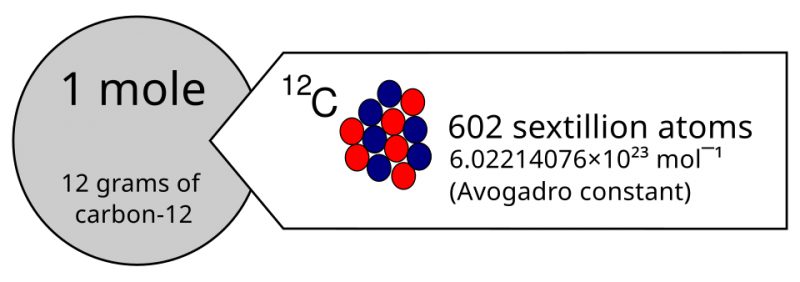
Why do we need the mole?
Atoms are far too small to count one by one. Just as we buy eggs by the dozen or paper by the ream, chemists group particles into a large bundle called the mole.
Molar mass
The mass of one mole in grams equals the atomic or molecular mass. Water H2O has a molecular mass of 18, so one mole weighs 18 g, about a small sip.
Formula: moles n = mass m ÷ molar mass M.
Moles of gases
At the same temperature and pressure, one mole of any gas occupies the same volume. At 0 °C and 1 atm it is about 22.4 litres, roughly a large water container.
Using moles in calculations
The equation 2H2 + O2 → 2H2O tells us 2 moles of hydrogen react with 1 mole of oxygen. Using moles, we can work out how many grams of raw materials give the desired amount of product, which is vital in factories and labs.
Japanese – English terms
物質量 (ぶっしつりょう) – amount of substance; モル (もる) – mole; アボガドロ定数 (アボガドロていすう) – Avogadro constant; モル質量 (モルしつりょう) – molar mass; 分子量 (ぶんしりょう) – molecular mass; モル体積 (モルたいせき) – molar volume.