
Middle Ages · World history
Silk Road シルクロード
しるくろーど
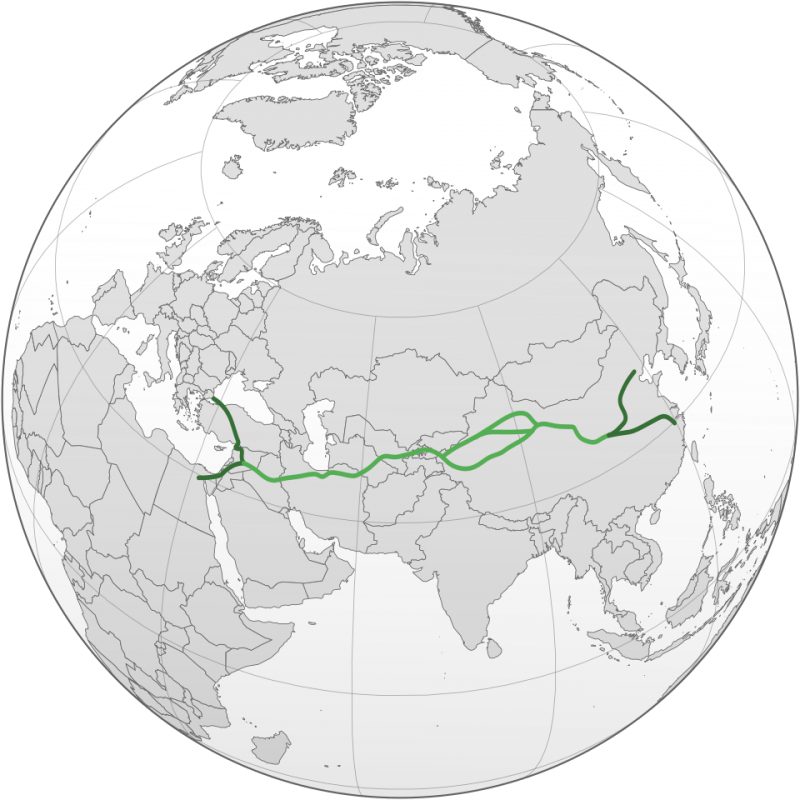
The Silk Road was a network of trade routes linking China with Central Asia, West Asia and the Mediterranean, active from the Han era (2nd century BC) to about the 15th century, carrying not only goods but religions, technologies and ideas.
- Ends
- Chang'an (Xi'an) – Mediterranean
- Main goods
- Silk, ceramics, spices, horses, glass
- UNESCO listing
- Chang'an–Tianshan Corridor (2014)
Not a single road
The name "Silk Road" was coined by German geographer Ferdinand von Richthofen in 1877. In fact it was many overland routes across the deserts and mountains of Central Asia, plus sea routes across the Indian Ocean, sometimes called the "Maritime Silk Road".
Few merchants traveled the whole way. Goods passed from oasis to oasis in stages, like a relay race. The Sogdians of Central Asia were famous middlemen.
Exchange of goods and cultures
Chinese silk was prized by Roman elites, while grapes, horses, glass and silver moved east. Papermaking, the compass and gunpowder gradually spread west from China.
Buddhism traveled these routes from India into China, then Korea and Japan; later Islam spread across Central Asia. Some objects in the Shosoin repository in Nara, Japan, came from Persia, so Nara is sometimes called the "eastern end of the Silk Road".
Rise and decline
The routes flourished under the Tang dynasty (618–907) and the Mongol Empire (13th–14th centuries), when one huge empire kept merchants safe; Marco Polo traveled them.
From the 15th–16th centuries, as European sea routes became cheaper and faster, the overland roads declined. The name is still used today to describe East–West exchange.
Japanese – English terms
シルクロード (しるくろーど): Silk Road; 交易 (こうえき): trade; 絹 (きぬ): silk; オアシス (おあしす): oasis; 隊商 (たいしょう): caravan; 東西交流 (とうざいこうりゅう): East–West exchange.