
Ancient world · World history
Ancient China: the Qin and Han dynasties 秦・漢
しん・かん
The Qin dynasty (221–206 BC) first unified China and standardized writing, measures and coinage; the Han (206 BC – AD 220) continued that unity for over 400 years and laid foundations of Chinese culture.
- Capitals
- Xianyang (Qin); Chang'an and Luoyang (Han)
- Key figures
- Qin Shi Huang, Liu Bang, Emperor Wu of Han
- Achievements
- Great Wall, paper, Records of the Grand Historian
Background: Spring and Autumn and Warring States
As the Zhou dynasty weakened, China split into rival states fighting almost constantly (roughly 8th–3rd centuries BC). This era of chaos was also one of the "Hundred Schools of Thought": Confucius, Laozi, Han Feizi and others proposed ways to govern.
The western state of Qin adopted Legalism, using strict laws and clear rewards and punishments to build wealth and military strength.
Qin Shi Huang unifies China
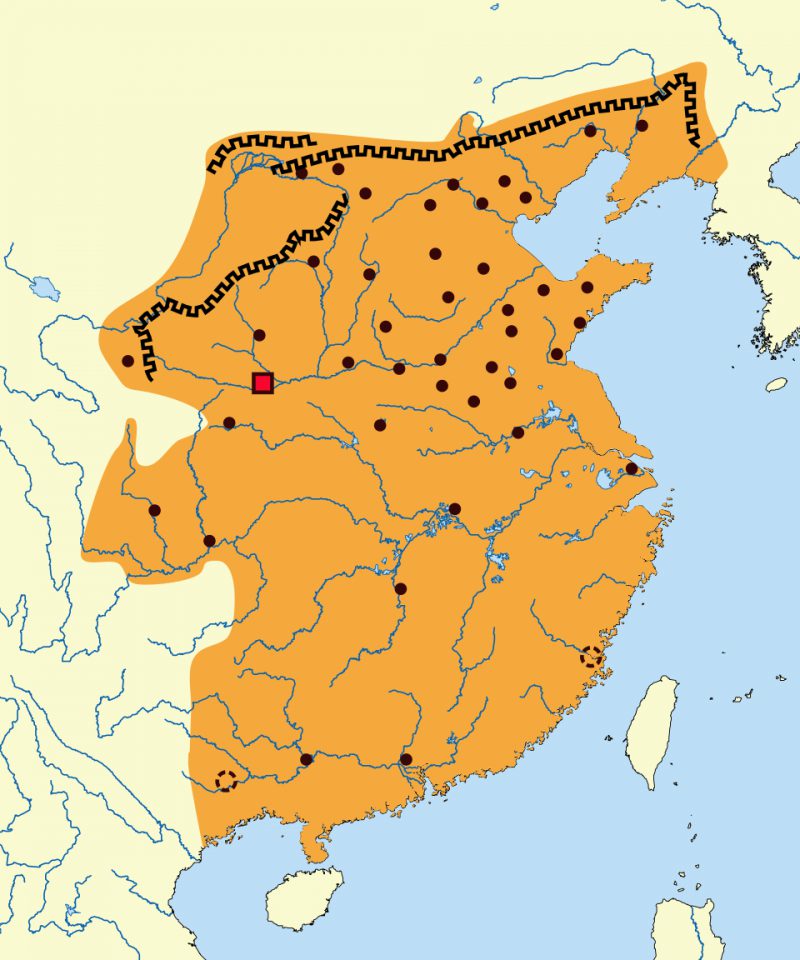
In 221 BC the king of Qin unified the states and called himself "First Emperor". He abolished hereditary fiefs, divided the land into commanderies and counties run by appointed officials, and standardized script, weights and measures, coinage and axle widths.
He linked northern walls against nomads, a forerunner of the Great Wall. His tomb, with thousands of terracotta soldiers, was discovered in 1974. Harsh rule brought the dynasty down after only about 15 years.
The Han dynasty and its legacy
Liu Bang founded the Han in 206 BC. Emperor Wu (r. 141–87 BC) made Confucianism the official ideology, expanded territory and sent Zhang Qian west, opening the way for the Silk Road.
During the Han, Sima Qian wrote the Records of the Grand Historian, and Cai Lun is credited with improving papermaking (AD 105). Chinese people still call themselves "Han" and their script "Han characters".
Japanese – English terms
始皇帝 (しこうてい): First Emperor (Qin Shi Huang); 郡県制 (ぐんけんせい): commandery-county system; 万里の長城 (ばんりのちょうじょう): Great Wall of China; 儒教 (じゅきょう): Confucianism; 諸子百家 (しょしひゃっか): Hundred Schools of Thought; 兵馬俑 (へいばよう): Terracotta Army.