
Middle Ages · World history
Mongol Empire モンゴル帝国
もんごるていこく
Founded by Genghis Khan in 1206, the Mongol Empire grew within about 70 years into the largest contiguous land empire in history, stretching from East Asia to Eastern Europe.
- Founder
- Genghis Khan (Temüjin)
- Capitals
- Karakorum; later Dadu (Beijing) under the Yuan
- Greatest extent
- About 24 million km² (late 13th century)
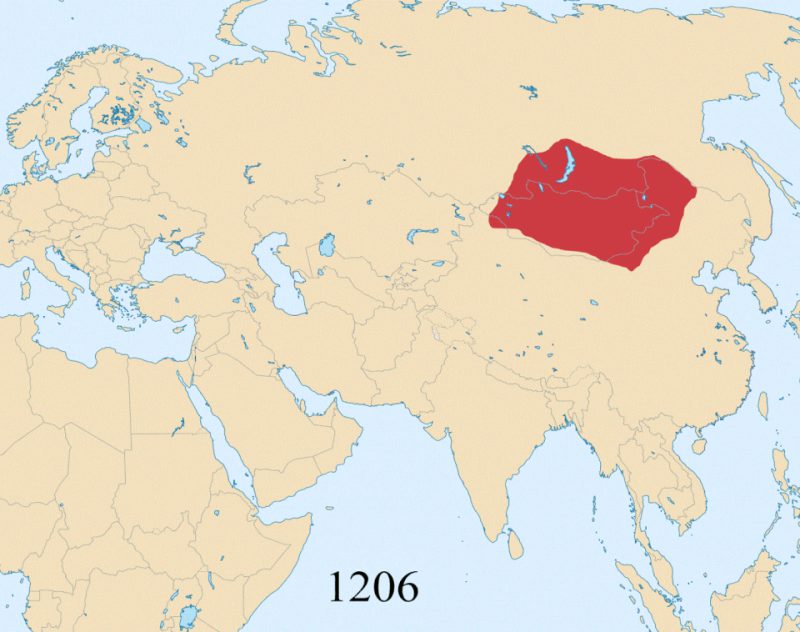
From steppe to empire
The Mongols were nomadic herders, expert riders and archers. In 1206 Temüjin united the tribes and was proclaimed Genghis Khan. He organized a disciplined, mobile army in decimal units of 10, 100 and 1,000.
His successors conquered Central Asia, Persia, Russia and reached Poland and Hungary. In 1271 Kublai Khan founded the Yuan dynasty and later took all of China.
The Mongols and Asia
The Yuan twice invaded Japan (1274 and 1281), known in Japanese as "Genkō"; both failed, partly because of storms. Yuan forces also attacked Đại Việt and Champa several times in the 13th century without success.
The conquests caused great destruction and loss of life in many regions, which historians regard as a major dark side of the empire.
Pax Mongolica and fragmentation
Once stable, the empire made East–West trade on the Silk Road safer, a period called the "Pax Mongolica". A relay-station system (yam) let envoys and merchants travel quickly; Marco Polo reached the Yuan court in this era.
From the mid-13th century the empire split into khanates (such as the Golden Horde, the Ilkhanate and the Chagatai Khanate) and the Yuan. In 1368 the Ming drove the Yuan from China. A common view is that these trade links also helped the Black Death reach Europe.
Japanese – English terms
遊牧民 (ゆうぼくみん): nomads; ハン (はん): khan; 元寇 (げんこう): Mongol invasions of Japan; 駅伝制 (えきでんせい): relay-station system; ハン国 (はんこく): khanate; 征服 (せいふく): conquest.