
Ancient world · World history
Ancient Rome 古代ローマ
こだいろーま
Ancient Rome grew from a small Italian city into an empire around the Mediterranean, leaving a great legacy in law, architecture, the Latin language and Christianity.
- Government
- Kingdom → Republic (509 BC) → Empire (27 BC)
- Capital
- Rome
- Legacy
- Roman law, Latin, roads, aqueducts
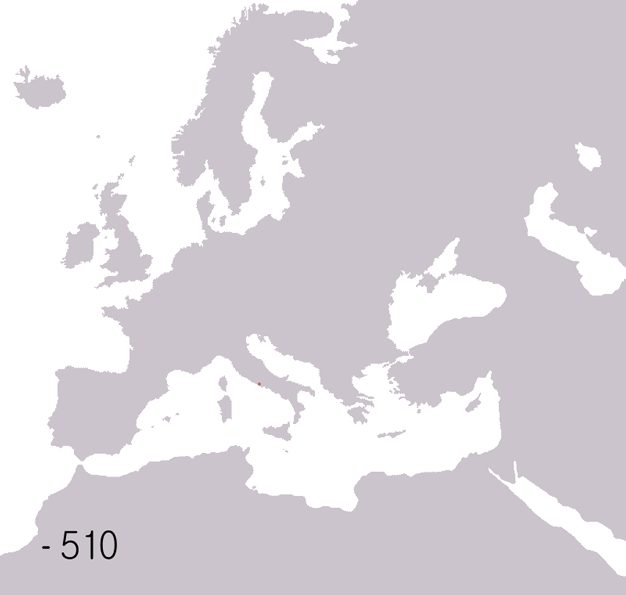
From republic to empire
In 509 BC the Romans overthrew their king and founded a republic: two consuls were elected each year, and the Senate of aristocrats held great influence. After wars with Carthage (the Punic Wars), Rome dominated the Mediterranean.
Long internal strife led to the rise of Julius Caesar, assassinated in 44 BC. In 27 BC Octavian took the title Augustus, beginning the imperial era.
Pax Romana and Roman life
The roughly 200 years after Augustus are called the Pax Romana ("Roman Peace"). Tens of thousands of kilometers of roads, aqueducts bringing clean water to cities, and the Colosseum holding tens of thousands of spectators date from this era, as does the saying "All roads lead to Rome".
Roman law defined citizens' rights, contracts and property; many of its principles survive in the civil law of Europe and Japan today.
Christianity and division
Christianity arose in Roman Palestine in the 1st century. Once persecuted, it was recognized by Emperor Constantine in 313 and became the state religion in the late 4th century.
In 395 the empire split into East and West. The Western Empire weakened under Germanic migrations and fell in 476, often taken as the end of antiquity in Europe. The Eastern (Byzantine) Empire lasted until 1453.
Japanese – English terms
共和政 (きょうわせい): republic; 元老院 (げんろういん): Senate; 帝政 (ていせい): imperial rule; ローマ法 (ろーまほう): Roman law; 水道橋 (すいどうきょう): aqueduct; 属州 (ぞくしゅう): province.