
Modern physics · Physics
Quantum mechanics 量子力学
りょうしりきがく
Quantum mechanics describes the world of atoms and particles, where energy comes in small packets (quanta), particles behave like waves and measurements can only be predicted as probabilities.
- Founders
- Planck, Einstein, Bohr, Heisenberg, Schrödinger
- Developed
- 1900–1920s
- Applications
- Semiconductors, lasers, MRI, quantum computers
Energy comes in quanta
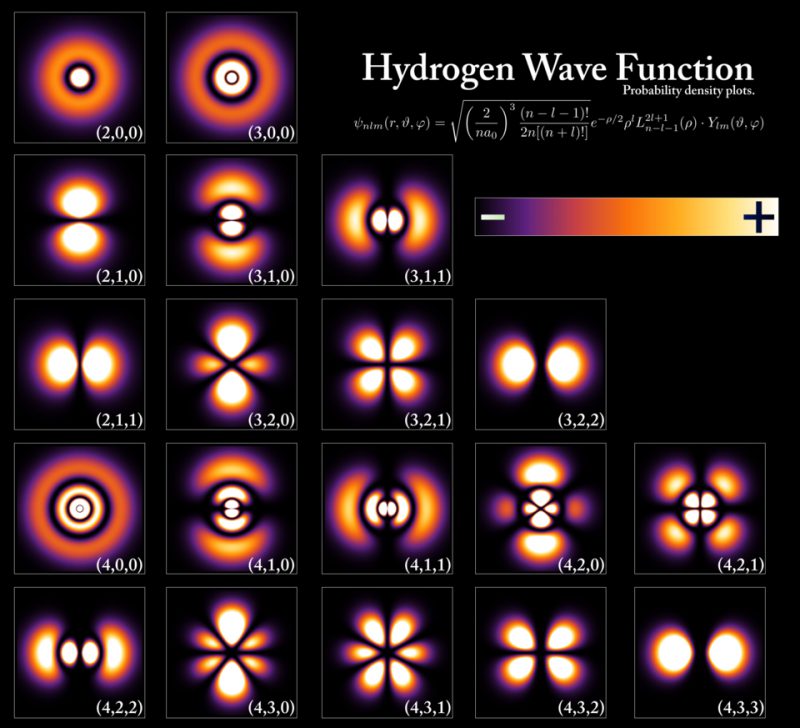
In 1900 Planck proposed that light is emitted in packets E = h × f. In 1905 Einstein explained the photoelectric effect: light is made of photons, and only photons with enough energy knock electrons out of a metal, however bright the light. Electrons in atoms also have only discrete energy levels, like stairs rather than a ramp.
Wave-particle duality
Fire electrons one by one through two slits and an interference pattern, like a wave's, slowly builds up on the screen. De Broglie proposed every particle has a wavelength λ = h / p. Electron microscopes use electrons' very short wavelength to see details far smaller than optical microscopes can.
Probability, uncertainty and entanglement
The wave function only gives the probability of finding a particle somewhere. Heisenberg's uncertainty principle says position and momentum cannot both be known exactly. Particles can be in superpositions or entangled, the basis of quantum computers and quantum cryptography now under research.
Japanese – English terms
量子 (りょうし) – quantum; 光子 (こうし) – photon; 光電効果 (こうでんこうか) – photoelectric effect; エネルギー準位 (えねるぎーじゅんい) – energy level; 波動関数 (はどうかんすう) – wave function; 不確定性原理 (ふかくていせいげんり) – uncertainty principle; 量子もつれ (りょうしもつれ) – quantum entanglement.