
Modern physics · Physics
Superconductivity 超伝導
ちょうでんどう
Superconductivity is the complete loss of electrical resistance in some materials cooled below a critical temperature, along with expulsion of magnetic fields. It is used in MRI scanners, particle accelerators and maglev trains.
- Discovered by
- Heike Kamerlingh Onnes (1911, mercury)
- Theory
- BCS theory (1957)
- Applications
- MRI, accelerators, maglev
Zero resistance
In 1911 Kamerlingh Onnes cooled mercury with liquid helium and saw its resistance suddenly vanish at about 4 K. In a superconducting loop a current can flow indefinitely without loss. BCS theory explains that at low temperature electrons form pairs that move without resistance.
The Meissner effect
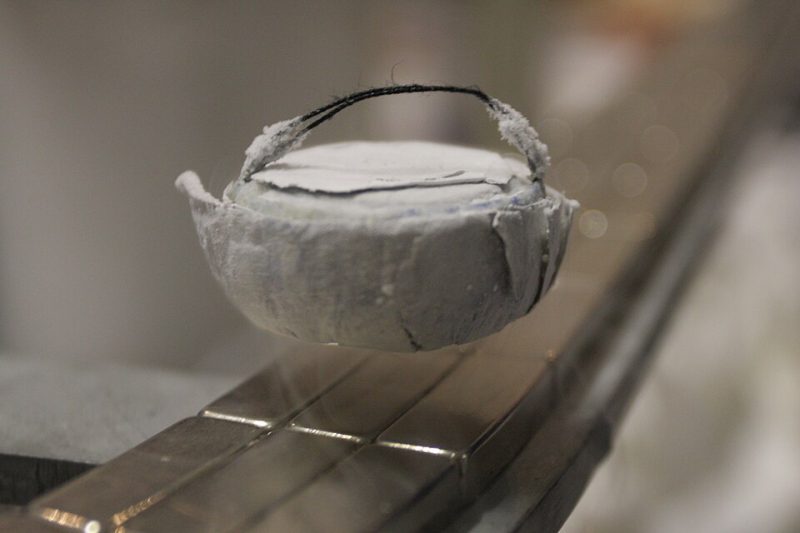
A superconductor expels magnetic fields from its interior, so a small magnet can float above a cooled superconductor. This is the hallmark of true superconductivity, not just a very good conductor.
High-temperature superconductors and uses
In 1986 copper-oxide ceramics were found that superconduct at much higher temperatures, some needing only cheap liquid nitrogen (77 K) instead of helium. Superconducting magnets create strong fields in MRI machines and the LHC. Japan's Chuo Shinkansen maglev uses superconducting magnets. Room-temperature superconductivity at ordinary pressure has not been confirmed.
Japanese – English terms
超伝導 (ちょうでんどう) – superconductivity; 臨界温度 (りんかいおんど) – critical temperature; マイスナー効果 (まいすなーこうか) – Meissner effect; 液体ヘリウム (えきたいへりうむ) – liquid helium; 液体窒素 (えきたいちっそ) – liquid nitrogen; 超伝導磁石 (ちょうでんどうじしゃく) – superconducting magnet.