
Stars & the cosmos · Earth & the universe
Life cycle of stars 恒星の一生
こうせいのいっしょう
Stars are born in nebulae, live by fusing hydrogen, and end as white dwarfs, neutron stars or black holes depending on their mass.
- Key factor
- Initial mass
- Longest stage
- Main sequence
- Classification tool
- Hertzsprung-Russell diagram
Birth
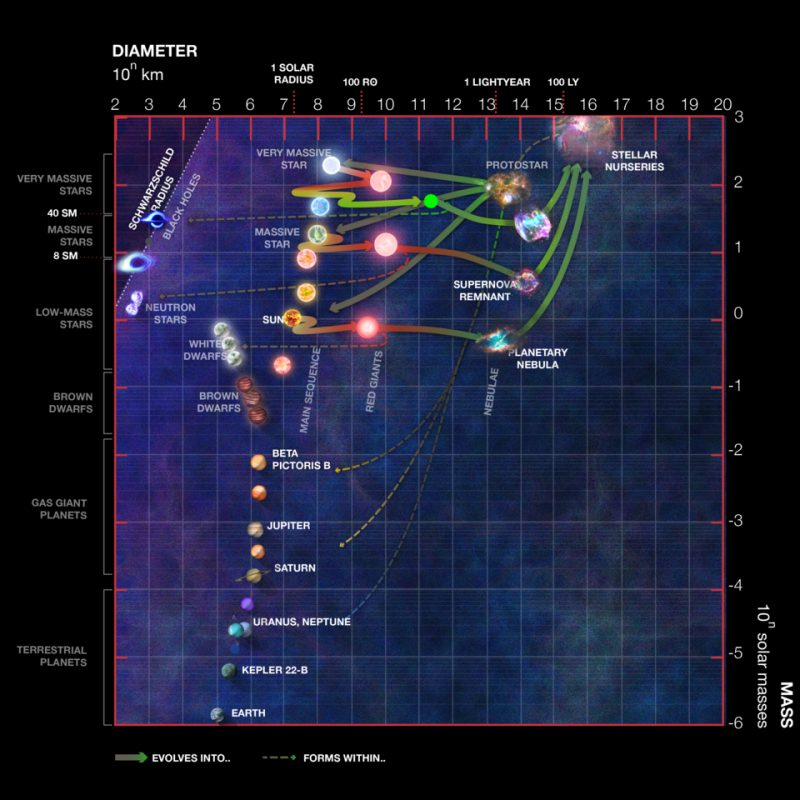
Inside a nebula, dense pockets of gas collapse under gravity and heat up. When the core reaches about 10 million °C, hydrogen fusion ignites and a star is born. The Orion Nebula is a stellar nursery visible with binoculars.
Adulthood
Most of a star's life is the main sequence, when inward gravity balances the outward pressure of fusion. Heavier stars burn faster: a star many times the Sun's mass lives only a few million years, while red dwarfs may last trillions.
Death
A Sun-like star swells into a red giant, puffs off its outer layers as a planetary nebula and leaves a white dwarf. Stars above about 8 solar masses explode as supernovae, leaving a neutron star or black hole. Many elements around us, like iron and gold, were forged in stars and such explosions.
Japanese – English terms
Vocabulary: 恒星 (こうせい) – star; 星雲 (せいうん) – nebula; 主系列星 (しゅけいれつせい) – main-sequence star; 赤色巨星 (せきしょくきょせい) – red giant; 白色矮星 (はくしょくわいせい) – white dwarf; 超新星 (ちょうしんせい) – supernova; 中性子星 (ちゅうせいしせい) – neutron star.