
The solar system · Earth & the universe
Solar and lunar eclipses 日食・月食
にっしょく・げっしょく
A solar eclipse happens when the Moon blocks the Sun; a lunar eclipse when the Moon enters Earth's shadow. Both need the Sun, Earth and Moon to line up.
- Lunar eclipse occurs at
- Full moon
- Solar eclipse types
- Total, annular, partial
- Safety
- Never look directly at the Sun
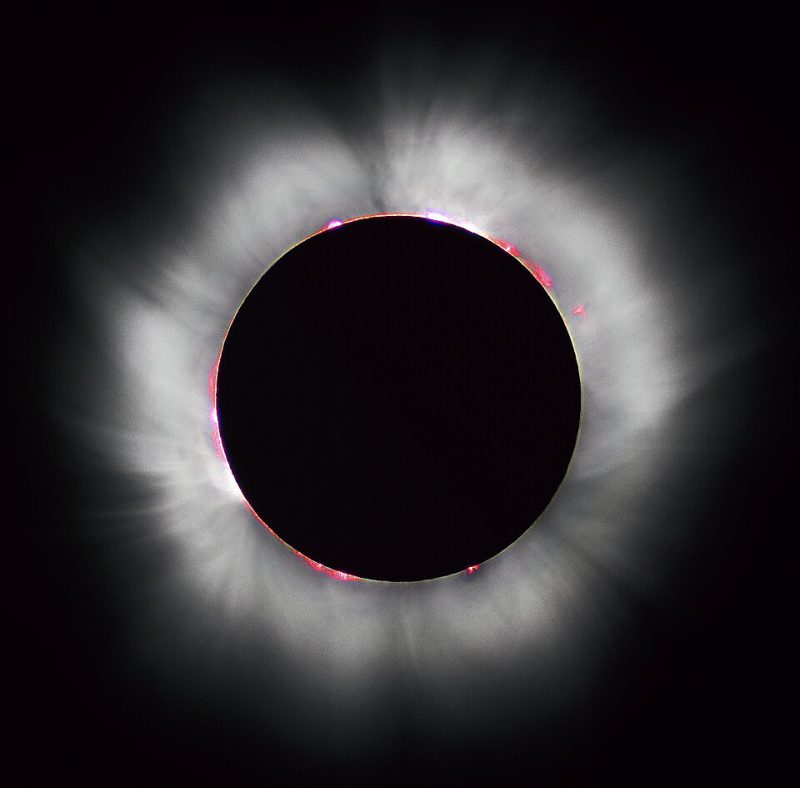
Solar eclipses
The Sun is about 400 times wider than the Moon but also about 400 times farther away, so they look almost the same size. When the Moon covers the Sun completely, day turns dark and the corona appears. When the Moon is farther, a bright ring remains: an annular eclipse.
Lunar eclipses
When Earth sits between the Sun and the Moon, its shadow falls on the Moon. During a total lunar eclipse the Moon often turns coppery red because Earth's atmosphere bends red light onto it, like the colours of sunset.
Why not every month
The Moon's orbit is tilted about 5 degrees to Earth's, so in most months it passes above or below the line. Eclipses happen only when a new or full moon coincides with the Moon crossing Earth's orbital plane.
Japanese – English terms
Vocabulary: 日食 (にっしょく) – solar eclipse; 月食 (げっしょく) – lunar eclipse; 皆既日食 (かいきにっしょく) – total solar eclipse; 金環日食 (きんかんにっしょく) – annular eclipse; コロナ – corona; 影 (かげ) – shadow.